
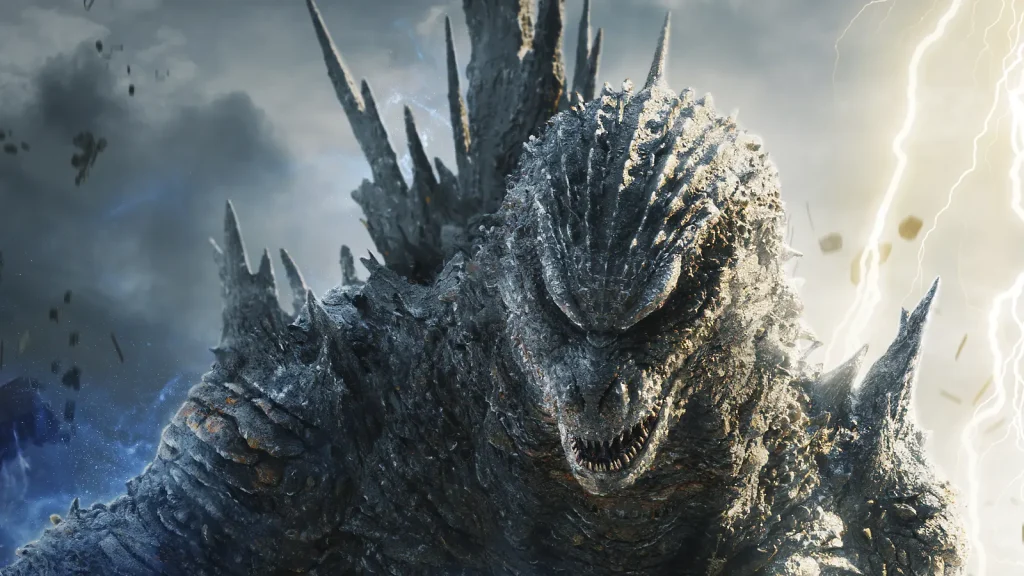
A few days before its French release on 4 November 2026, Godzilla Minus Zero is generating as much interest for its images as for its story. After the Oscar for Best Visual Effects won by Godzilla Minus One, Takashi Yamazaki returns as director, screenwriter and visual effects supervisor. The film also marks a milestone announced by Toho: the first Japanese production “Filmed For IMAX”. But behind that label, what actually changes on screen?
This feature separates officially announced information from the general principles of effects-driven filmmaking. It does not invent a budget, a number of digital shots or production methods that the team has not documented.
The 6 key facts to remember
| Topic | Verified information |
|---|---|
| Release in France and Belgium | 4 November 2026 |
| Release in Japan | 3 November 2026 |
| Release in the United States and Canada | 6 November 2026 |
| Creative lead | Takashi Yamazaki: director, screenwriter and VFX supervisor |
| Setting | 1949, two years after the events of Minus One |
| Filming innovation | Japanese production “Filmed For IMAX”, with IMAX-certified digital cameras |
Why the move to IMAX is a genuine directing decision
A film can be shown in an IMAX auditorium without having been designed for the format from the shoot onwards. Godzilla Minus Zero belongs to a different category: Toho and GKIDS present it as the first Japanese “Filmed For IMAX” project. It was shot with IMAX-certified high-definition digital cameras, then prepared for the image and sound characteristics of those auditoriums.
Official promotional material confirms that certain sequences use framing that reaches up to 1,43:1. This aspect ratio is taller than the usual widescreen format. It gives the frame a vertical dimension that is particularly useful for showing a gigantic monster, buildings and the people at its feet all at once.
1.43:1: what the figure means
A 1.43:1 ratio means an image is 1.43 units wide for every unit of height. For viewers, the difference is not “more pixels” by definition: it is above all a different shot composition. The same fight can leave more visible space above or below the subject, when the sequence and the cinema’s equipment allow it.
Note: not every IMAX-branded auditorium necessarily offers the same screen geometry. The trailer proves that some passages are in 1.43:1; it does not guarantee that every French screening will show the whole film in that framing. The best approach is to check the cinema and auditorium you choose.
Practical effects and digital imagery: what the behind-the-scenes footage really tells us
Toho and GKIDS have released an official behind-the-scenes video. It shows fragments of the shoot and the physical scale of the sets. It is worth being precise, though: this video is not a complete inventory of the sets, miniatures or tools used.
In a monster film, the credibility of destruction often comes from consistency between several layers : the actors’ performances, on-set lighting, set elements, camera movement, dust simulation and the integration of digital creatures. This framework describes how a visual effects shot usually works; it does not claim to reveal a technique exclusive to Minus Zero.
Building a spectacular shot: five questions to look at the images differently
- Scale: do the people and buildings immediately convey the monster’s size?
- Light: do the creature’s shadows and reflections match those of the filmed sets?
- Movement: does the camera react to the chaos in a readable way, without making the action incomprehensible?
- Material: do water, smoke, dust and debris follow plausible trajectories?
- Sound: does the ambient sound build up to the impact before Godzilla fully appears?
This is exactly the kind of visual and sound consistency that the new IMAX format puts to the test. The size of the screen makes continuity flaws more visible, but it can also amplify the sense of space when shots are designed for it.
The real narrative stake: rebuilding Japan in 1949
The first official teaser sets the story in 1949, two years after Godzilla Minus One. The country is trying to return to normal life after the previous disasters. The appeal of this period is therefore not just aesthetic: it shows a society learning to live again before facing a new threat.
Ryunosuke Kamiki returns as Koichi Shikishima and Minami Hamabe reprises her role as Noriko Oishi. The studio has also announced the return of several characters from the first film, including Kenji Noda (Hidetaka Yoshioka), Shiro Mizushima (Yuki Yamada) and Seiji Akitsu (Kuranosuke Sasaki). The approach remains a human drama facing an overwhelming catastrophe, rather than a simple catalogue of explosions.
The trailer also introduced Makoto Aoyama, played by Masami Nagasawa, a weather specialist attached to the disaster response office. These elements raise the stakes without revealing the ending.
A short, sourced release timeline
| Date | What was announced |
|---|---|
| 14 April 2026 | First official look: story set in 1949, return of the main characters and “Filmed For IMAX” announcement. |
| 26 August 2026 | Toho and GKIDS release a behind-the-scenes clip from the shoot. |
| 8 September 2026 | New trailer and confirmation of sequences in the 1.43:1 ratio. |
| 3 November 2026 | Japanese release. |
| 4 November 2026 | Announced release in France and Belgium. |
| 6 November 2026 | North American release. |
“Filmed For IMAX” does not mean “shot entirely in IMAX 70mm”
The distinction deserves a paragraph of its own. Official press releases refer to IMAX-certified digital cameras. They therefore do not allow us to say that the entire film was captured on IMAX 70mm film, nor that every scene uses the 1.43:1 ratio. The two statements are different and should not be confused.
Likewise, IMAX in cinemas is not the same as HDR on a television. The first refers mainly to a projection experience and certain image formats; the second describes the dynamic range and brightness information in the picture. To understand the second, see our HDR10 vs Dolby Vision comparison.
What the studio has confirmed — and what it has not yet detailed
| Officially confirmed | Not to be presented as established |
|---|---|
| Yamazaki returns as director, screenwriter and VFX lead. | A precise production or visual effects budget. |
| IMAX-certified digital cameras and passages in 1.43:1. | A full 1.43:1 presentation in every cinema. |
| A direct sequel set in 1949 Japan. | Details of unrevealed scenes, creatures and twists. |
| Official making-of released by Toho/GKIDS. | The number of CGI shots, the size of the VFX team or the full list of software. |
Our view: Yamazaki’s gamble is as emotional as it is technical
By once again combining writing, directing and visual effects supervision, Yamazaki maintains an artistic continuity that is unusual at this level of international visibility. Vantstep’s editorial hypothesis is that the main challenge is not to make Godzilla bigger on screen, but to preserve the human point of view in front of it.
The production now has a strong argument for drawing audiences into cinemas: capture and composition designed for large IMAX screens. It remains to be seen, on release, whether this spectacular promise serves the story. We will update this feature after the first French screenings, keeping observations of the film separate from promotional announcements.
Frequently asked questions about Godzilla Minus Zero
When is Godzilla Minus Zero released in France?
The official international Godzilla release calendar gives 4 November 2026 for France and Belgium.
Is it a sequel to Godzilla Minus One?
Yes. Toho’s materials set the story two years after the events of the previous film, in 1949, with several returning characters.
Is the whole film in 1.43:1 IMAX?
Official communications refer to certain sequences in this format. You should not conclude that every shot or every screening will be in 1.43:1.
Do we know the exact visual effects budget?
Not from the official sources checked here. A figure without a reference publication would be speculation.
Primary sources consulted
- Godzilla / Toho: worldwide release calendar.
- Godzilla / Toho–GKIDS: behind-the-scenes video and IMAX camera.
- Godzilla: trailer, 1.43:1 format and cast.
- Godzilla: first teaser, 1949 setting and characters.
Article prepared by the Vantstep newsroom on 1 November 2026; information may change on cinema release.
Cover image: © 2026 TOHO Co., Ltd. — promotional material for the film released by Apollo Films.