
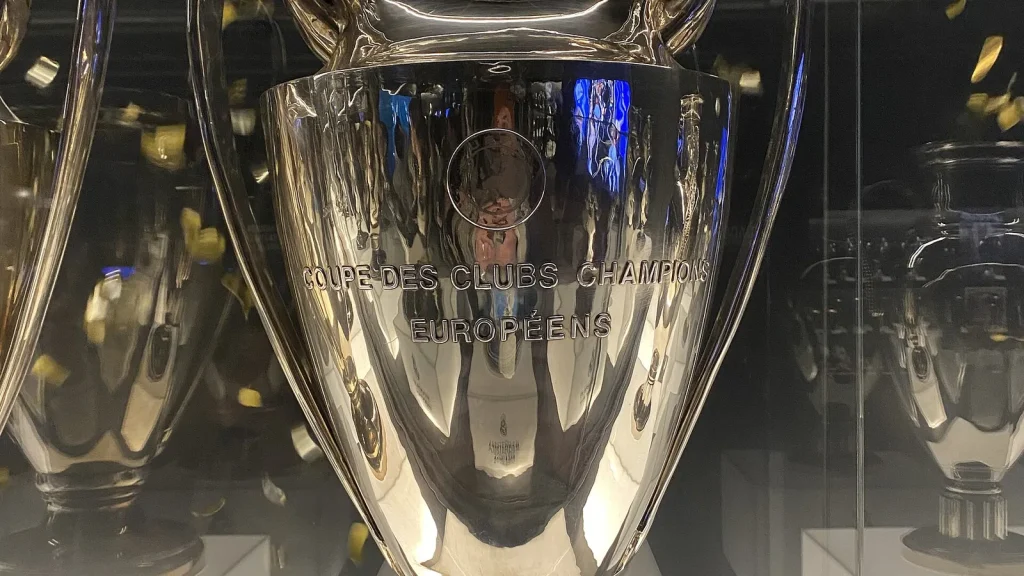
Key points: the first matchday of the 2026-27 Champions League did not just produce spectacular scores. It has already sketched several trends: Real Madrid accept defending deep to accelerate better, Paris Saint-Germain turn their off-the-ball movement into chances, Barça press with renewed intensity and the newcomers refuse to be extras.
Here is a tactical reading based on the official results and the observations published by UEFA. The aim is not to draw definitive conclusions after a single match, but to identify the signals that could matter in the coming matchdays.
The results that stood out on matchday 1
| Match | Result | Main signal |
|---|---|---|
| Real Madrid vs Inter | 2-1 | Quick transitions despite only 36% possession |
| Paris Saint-Germain vs Slovan Bratislava | 6-1 | Constant movement and efficiency in the box |
| Barcelona vs Feyenoord | 5-1 | High pressing and runs in behind the defence |
| Bayern vs Bodø/Glimt | 5-0 | Width, penetration and late finishing |
| Como vs Leipzig | 4-1 | A debutant able to create overloads in midfield |
| Napoli vs Arsenal | 0-1 | Control through passing and patience in build-up |
| Slavia Prague vs Lens | 2-3 | Character and efficiency from the French club away from home |
1. Real Madrid can win without controlling the ball
The 2-1 win over Inter offers the most interesting lesson of the week. According to UEFA’s analysis unit, Real Madrid had only 36% possession, their lowest home figure in the competition in a decade. Yet the team produced a very high proportion of shots inside the box.
The plan rested on three ideas: protect the centre, use the wingers to close passing lanes inside and trigger aggressive pressure on certain cues. Federico Valverde’s goal in the 23rd minute came from this mechanism. Real switched from a compact block to quick man-to-man pressure, forcing an error from the opposing goalkeeper.
This approach, however, requires a decisive goalkeeper. Thibaut Courtois made seven saves from the eight shots on target he faced. The score validates the plan, but it also shows that Madrid let Inter into dangerous areas.
2. Transitions have become a central weapon again
In a competition where many teams try to monopolise the ball, Real showed that a team can deliberately accept a defensive phase to attack a better-prepared space. The important detail is the players’ positions when the ball is won back: if the forwards stay too deep, the counter becomes impossible; if they stay too high, the block defends outnumbered.
Madrid’s solution was to vary. Early in the match, the forwards took more part in the block. In the last half-hour, some stayed higher to exploit the space, eventually creating a four-against-three in the Italian half.
3. Paris have found a finisher, but above all a system
PSG beat Slovan Bratislava 6-1 and Ferran Torres scored his first hat-trick for the club. The figure naturally grabs attention, but UEFA above all highlighted his movement. Torres made repeated short runs, darts to the near post and changes of zone to arrive in the right place at the right time.
Such a performance does not rest on the scorer alone. It depends on the players who pin the defence, create the extra pass and force the centre-backs to watch the ball rather than the run. The question for Paris will be to reproduce these patterns against an opponent able to keep the ball and defend higher up.
4. Barça are pressing with their forwards again
Barcelona beat Feyenoord 5-1. Raphinha scored twice, but his influence went beyond finishing. UEFA’s technical observers highlighted the intensity of his pressing, his runs in behind and his ability to move between the lines.
The best sign for Barça is collective: when the front line presses in a coordinated way, the team wins the ball closer to goal and limits long defensive runs. The risk is well known. If a player steps out late, the opponent can attack the space left behind him. The coming fixtures will show whether this intensity can last 90 minutes against a stronger midfield.
5. Michael Olise changes Bayern’s rhythm
Bayern beat Bodø/Glimt 5-0. Michael Olise scored two late goals and provided an assist. His tactical value comes from his ability to receive wide, cut inside onto his stronger foot or combine in the half-space. The defender never knows whether to close the line or protect the inside.
Against a compact block, this profile is valuable: it lets Bayern avoid predictable crosses and create more varied attacks. The next step will be to maintain this quality against a team able to press the ball carrier and double up on the flank.
6. Como did not come to learn quietly
In their first appearance in the competition, Como beat Leipzig 4-1. Martin Baturina opened the scoring and provided an assist. His movement created overloads in midfield and let his team dominate an area Leipzig usually try to control.
This win does not immediately turn Como into title contenders, but it changes how future opponents see them. Teams that thought they could rest starters will now have to prepare this match more carefully.
7. Arsenal can also win a tight match
Arsenal won 1-0 in Naples. Martin Ødegaard completed more than 100 passes, created six chances and scored the winning goal. The result matters because it shows another side of Arsenal: the team can win without turning the match into an exchange of chances.
In this kind of match, passing only has value if it moves the opposing block. Ødegaard alternated safe passes and accelerations into creative zones. This patience could become a major advantage in a league phase where every point counts.
Frequently asked questions about the first matchday
Can Real defend this deep against every team?
Probably not. This plan works best if the opponent leaves space behind its full-backs. Against a cautious block, Madrid will need to build more.
Will Paris and Barça confirm it against a stronger rival?
The volume of goals is encouraging, but the quality of the opposition must be taken into account. The next big matches will offer a more revealing test of their defensive balance.
Can the surprises last?
Como and Lens won thanks to a clear plan and strong efficiency. To last, they will need to keep this intensity while managing fatigue and opponents’ adjustments.
Next step: see our analysed schedule for Champions League matchday 2.
Conclusion
The first matchday confirms that the Champions League can be won in several ways. Ball control remains useful, but pressing, protection after losing the ball and the quality of off-the-ball movement often made the difference. Real won on the transition, Arsenal through control, Paris and Barcelona through movement, while Como showed the value of a bold plan.
To prepare for the next matchday, see also our complete 2026-27 Champions League fixtures.
Sources: UEFA, results and fixtures ; UEFA Game Insights, Real Madrid vs Inter ; UEFA team of the week. Updated on 16 September 2026.